Disorders of the Bladder, Prostate & Seminal Vesicles
This chapter's centrepiece is benign prostatic hyperplasia (BPH) — the commonest benign tumour in men and the everyday reason older men develop voiding symptoms.
The big picture
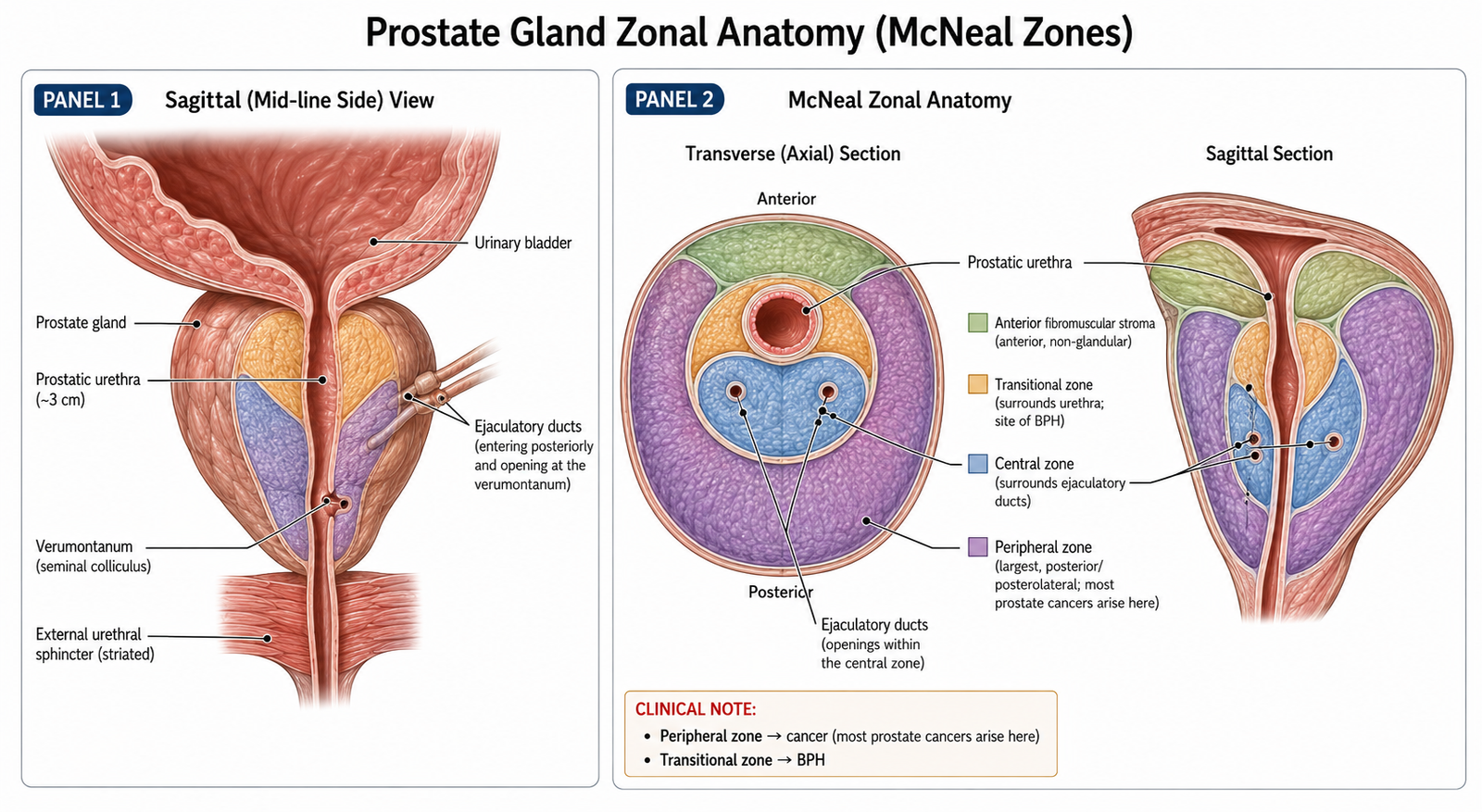
This chapter's centrepiece is benign prostatic hyperplasia (BPH) — the commonest benign tumour in men and the everyday reason older men develop voiding symptoms. It builds directly on anatomy (BPH grows in the transition zone, squeezing the urethra) and on the LUTS framework from the symptoms chapter. Alongside BPH sit the bladder-pain and prostatitis syndromes and seminal vesicle disorders. The practical skill is grading the man's symptoms, deciding when to treat, and choosing the right medical or surgical option.
The framework: BPH (mechanism → assessment with IPSS → medical → surgical), the prostatitis syndromes, interstitial cystitis/bladder pain syndrome, and seminal vesicle disorders.
Mechanism pathway
Tap any step to see why it happens.
The prostate — zones (McNeal)
Diagnostic algorithm
Each step answers one question. Tap to expand.
Board traps
BPH = transition zone hyperplasia → outlet obstruction → voiding LUTS (cancer is peripheral).
IPSS is the key tool for grading and following BPH.
Alpha-blockers (fast, dynamic) vs 5-alpha-reductase inhibitors (slow, shrink enlarged glands).
TURP is the surgical benchmark; urethral lift is an option for obstructing lateral lobes.
Seminal vesicle/vas agenesis found on infertility workup (links to cystic fibrosis).
Interstitial cystitis/bladder pain syndrome = frequency + pain, unknown cause, diagnosis of exclusion.
IPSS: 7 items × 0–5 = 0–35; bands 0–7 mild / 8–19 moderate / 20–35 severe — recommended for all patients before therapy.
Uroflowmetry, PVR, and pressure-flow studies are optional; full urodynamics is reserved for suspected neurologic disease or failed prostate surgery.
Pressure-flow distinguishes obstruction from an underactive detrusor.
Exclude stricture, bladder neck contracture, bladder stone, and prostate cancer before diagnosing BPH — ask about prior instrumentation/urethritis/trauma.
Renal insufficiency in ~10% of men with prostatism → image the upper tracts; complications (retention, stones, infection, refractory haematuria) push toward surgery.