Non-Muscle-Invasive Bladder Cancer & Intravesical Therapy
NMIBC is the common form of bladder cancer (Ta, T1, CIS) — confined to the mucosa/lamina propria, not into muscle. The whole game is risk stratification, because risk decides everything.
The big picture
NMIBC is the common form of bladder cancer (Ta, T1, CIS) — confined to the mucosa/lamina propria, not into muscle. The whole game is risk stratification, because risk decides everything: how aggressively you resect, whether you instil a single dose of chemo, whether you give a course of BCG, and when you abandon the bladder and go to cystectomy. It's a disease of recurrence and progression — managed by good resection plus the right intravesical therapy plus surveillance.
The framework: classify NMIBC (low / intermediate / high risk) → complete TURBT (± restaging) → match intravesical therapy to risk → surveil → early cystectomy for BCG failure/highest risk.
Mechanism pathway
Tap any step to see why it happens.
Bladder cancer — T-staging (depth of invasion)
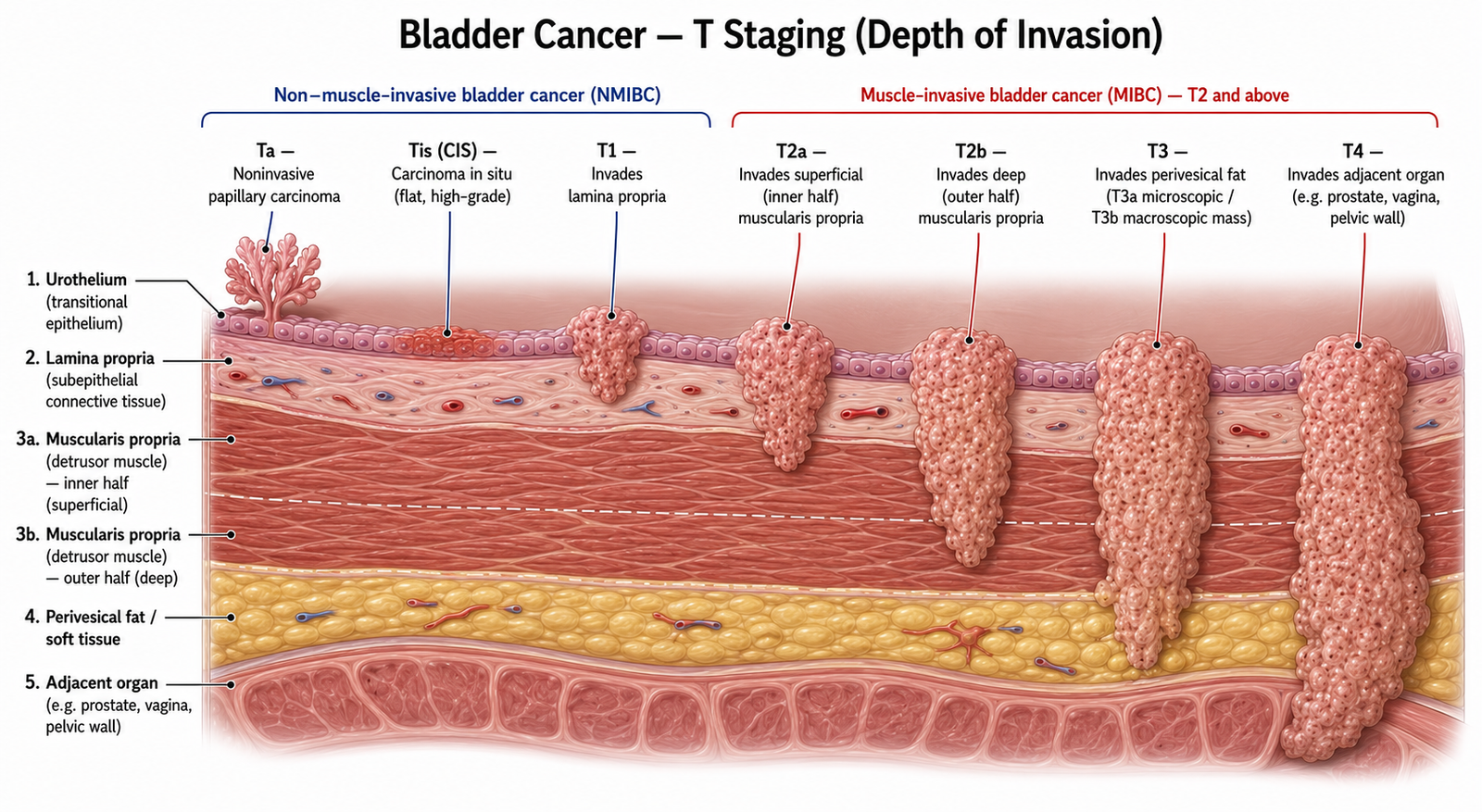
Interactive — treatment by stage (EAU + AUA)
Diagnostic algorithm
Each step answers one question. Tap to expand.
Board traps
NMIBC risk: low = solitary primary low-grade Ta <3 cm; intermediate = multiple/recurrent/large low-grade Ta; high = any high-grade (CIS, HG T1, HG Ta).
TURBT must contain muscle to stage; intravesical therapy fails if resection is incomplete.
Immediate single-dose intravesical chemo (MMC) within 6 hours reduces recurrence (not at 24 h).
High-grade T1 → restaging TURBT (frequently upstaged).
High risk → BCG induction + maintenance; BCG failure → early cystectomy.
CIS is flat, high-grade, aggressive — treat as high risk.