Muscle-Invasive & Metastatic Bladder Cancer
Once bladder cancer invades the muscle (≥T2), it is a lethal disease that demands aggressive, multimodal treatment — and the single most important advance is that chemotherapy comes BEFORE surgery (neoadjuvant), not after.
The big picture
Once bladder cancer invades the muscle (≥T2), it is a lethal disease that demands aggressive, multimodal treatment — and the single most important advance is that chemotherapy comes BEFORE surgery (neoadjuvant), not after. The standard of care is cisplatin-based neoadjuvant chemotherapy then radical cystectomy with pelvic lymph-node dissection, with trimodal bladder preservation as the organ-sparing alternative for selected patients.
The framework: confirm muscle invasion (≥T2) and stage → neoadjuvant cisplatin chemo → radical cystectomy + PLND + urinary diversion, or trimodal therapy for bladder preservation → systemic therapy for metastatic disease.
Mechanism pathway
Tap any step to see why it happens.
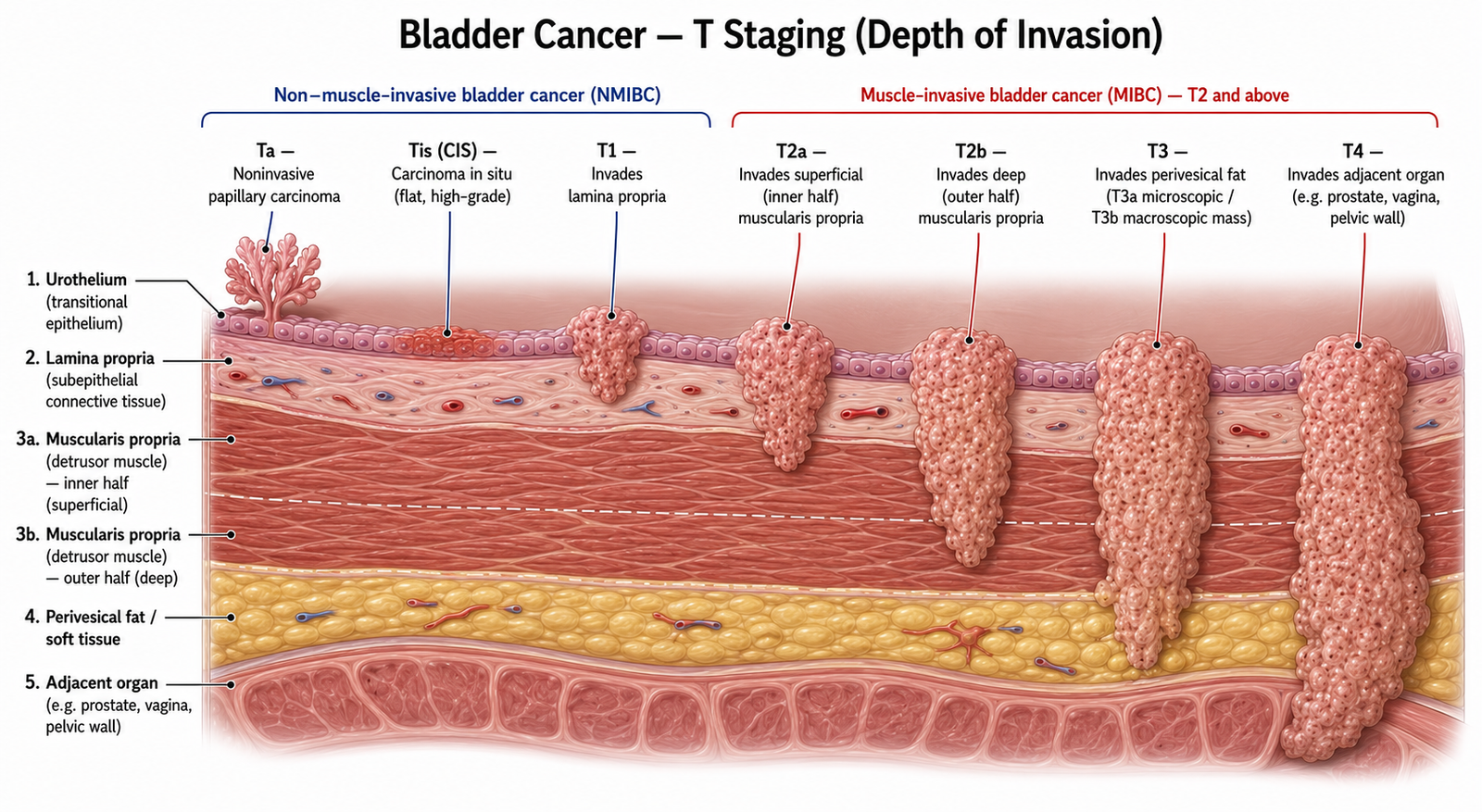
Bladder cancer — T-staging (depth of invasion)
Diagnostic algorithm
Each step answers one question. Tap to expand.
Board traps
Muscle invasion (≥T2) is the dividing line — changes everything from NMIBC.
Standard of care = cisplatin-based NEOADJUVANT chemo → radical cystectomy + bilateral PLND (chemo before surgery improves survival).
Trimodal therapy (maximal TURBT + chemo + RT) is the bladder-preserving alternative for selected patients.
Most bladder cancer is urothelial, smoking-linked.
Metastatic: cisplatin-based chemo, then checkpoint inhibitors / ADCs.
Cisplatin eligibility determines who benefits from standard chemo.