Cancer of the Prostate Gland
Prostate cancer is the most common non-skin cancer in men, and its defining clinical tension is that it ranges from indolent disease a man dies with to aggressive disease a man dies from.
The big picture
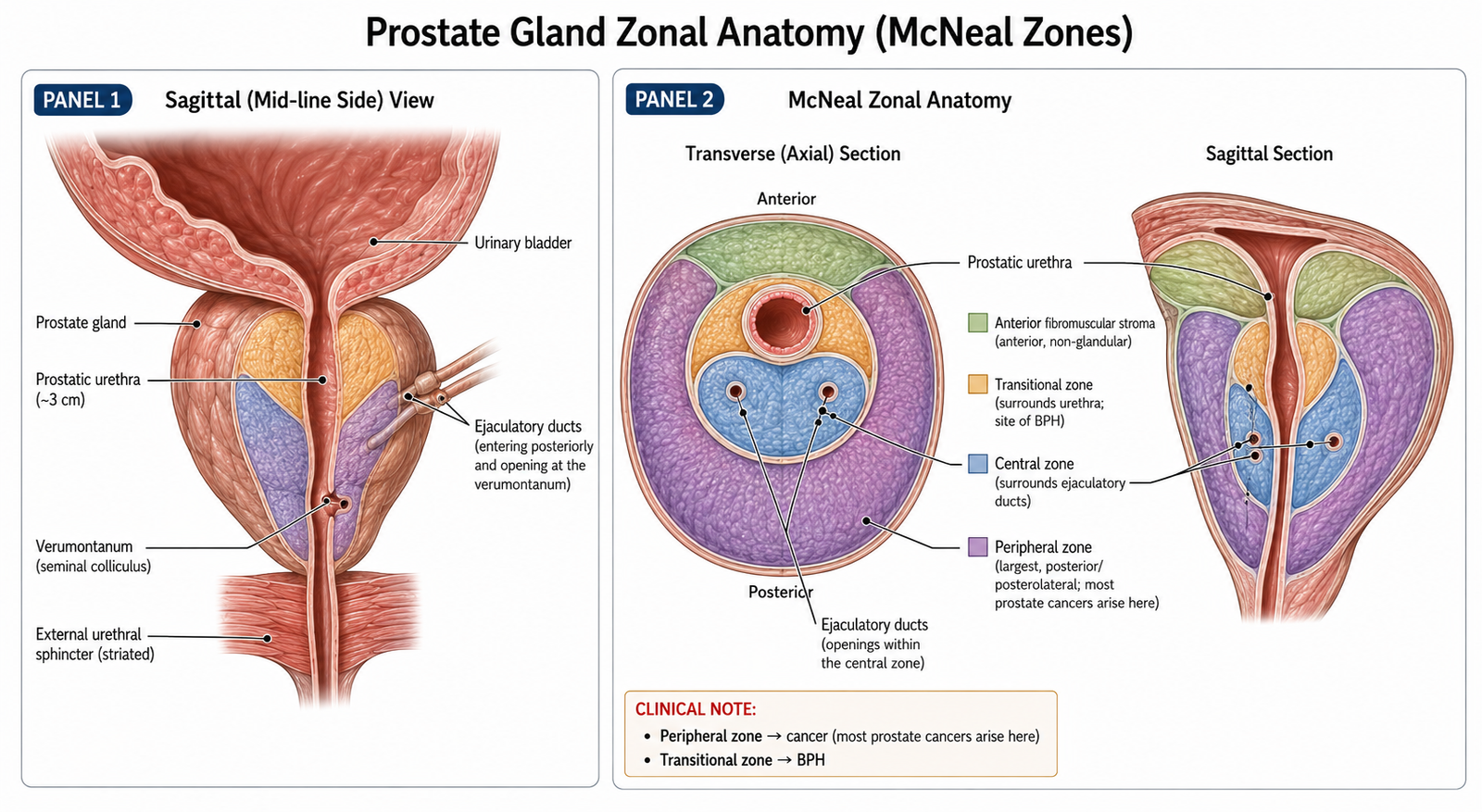
Prostate cancer is the most common non-skin cancer in men, and its defining clinical tension is that it ranges from indolent disease a man dies with to aggressive disease a man dies from. The whole art is telling those apart — which is why grading (Gleason / Grade Group), PSA, and the decision between active surveillance and radical treatment dominate the topic. Recall from anatomy why it behaves as it does: it arises in the peripheral zone, so it is palpable on DRE but obstructs late.
The framework: know the histology and location, the Gleason/Grade Group system, detection (PSA + DRE + biopsy), the metastatic pattern, and the treatment spectrum from surveillance to surgery to radiation to androgen deprivation.
Mechanism pathway
Tap any step to see why it happens.
The prostate — zones (McNeal)
Diagnostic algorithm
Each step answers one question. Tap to expand.
Board traps
~95% adenocarcinoma; ~70% arise in the peripheral zone (palpable on DRE, obstructs late).
A suspicious DRE → biopsy regardless of PSA (PSA is prostate- not cancer-specific).
Gleason score / Grade Group drives prognosis — sum the two commonest patterns.
Bone metastases are osteoblastic (sclerotic), not lytic.
Active surveillance is appropriate for low-risk disease — avoid overtreating indolent cancer; but it cannot replace a first biopsy.
Treatment links onward: localised → surgery/radiation; advanced → ADT → (recurrence/CRPC).