Build Your Knowledge
Foundations · AnatomyFoundations / Anatomy
Prostate Anatomy
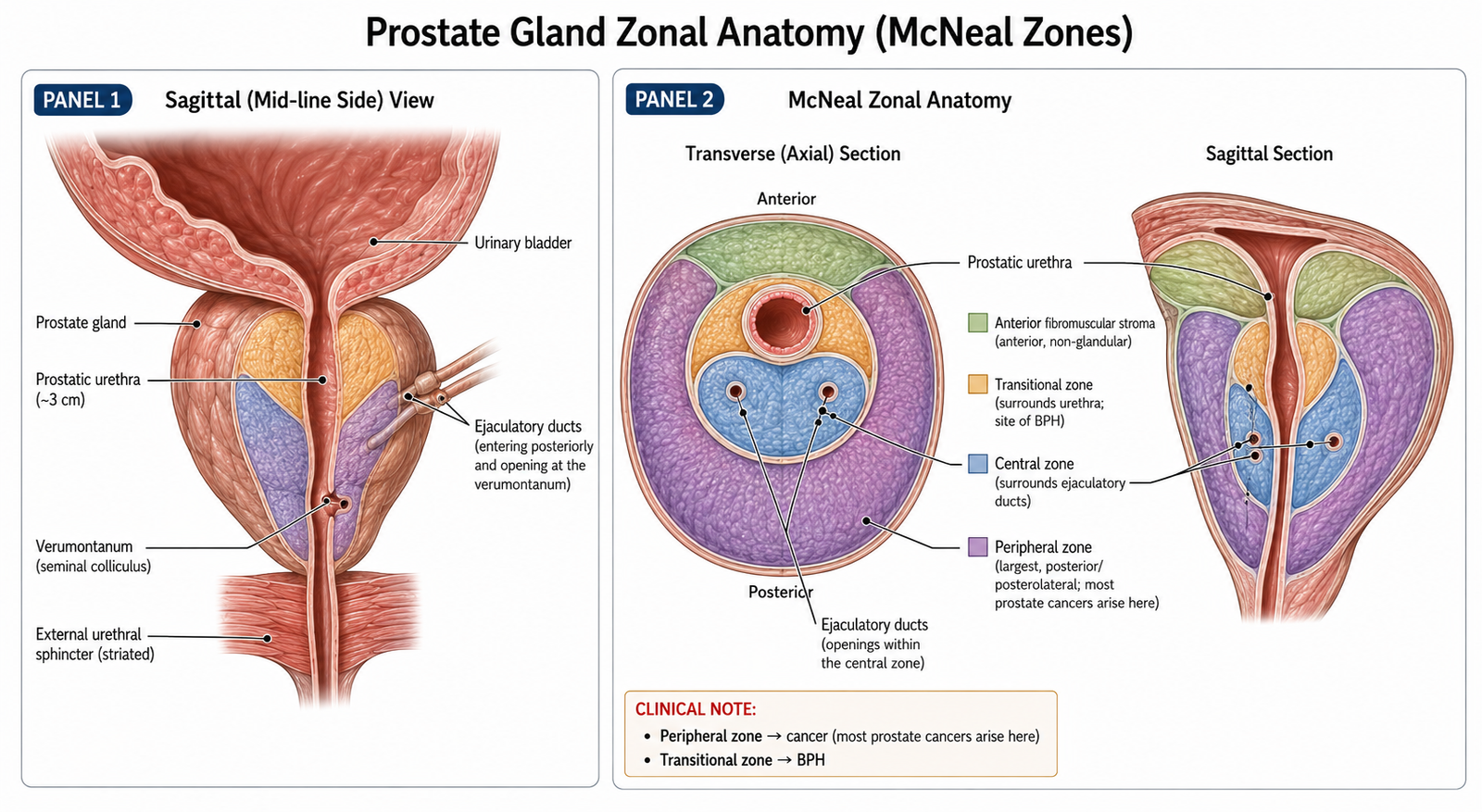
A walnut-sized gland wrapping the urethra below the bladder, whose McNeal zones are the single highest-yield prostate fact: transition zone → BPH, peripheral zone → most cancers.
Orientation
The big picture
Walnut-sized (~20 g), wraps the urethra below the bladder; the rectum sits just behind (separated by Denonvilliers' fascia) — which is why it is palpable on DRE.
Golden rule
BPH = transition zone; most prostate cancer = peripheral zone; the central zone surrounds the ejaculatory ducts.
Pathophysiology
Mechanism pathway
Tap any step to see why it happens.
Illustration
The prostate — zones (McNeal)
Exam
Board traps
BPH = transition zone; prostate cancer = peripheral zone.
The central zone surrounds the ejaculatory ducts; the rectum sits behind (Denonvilliers' fascia) → palpable on DRE.
Test yourself